
Introduction
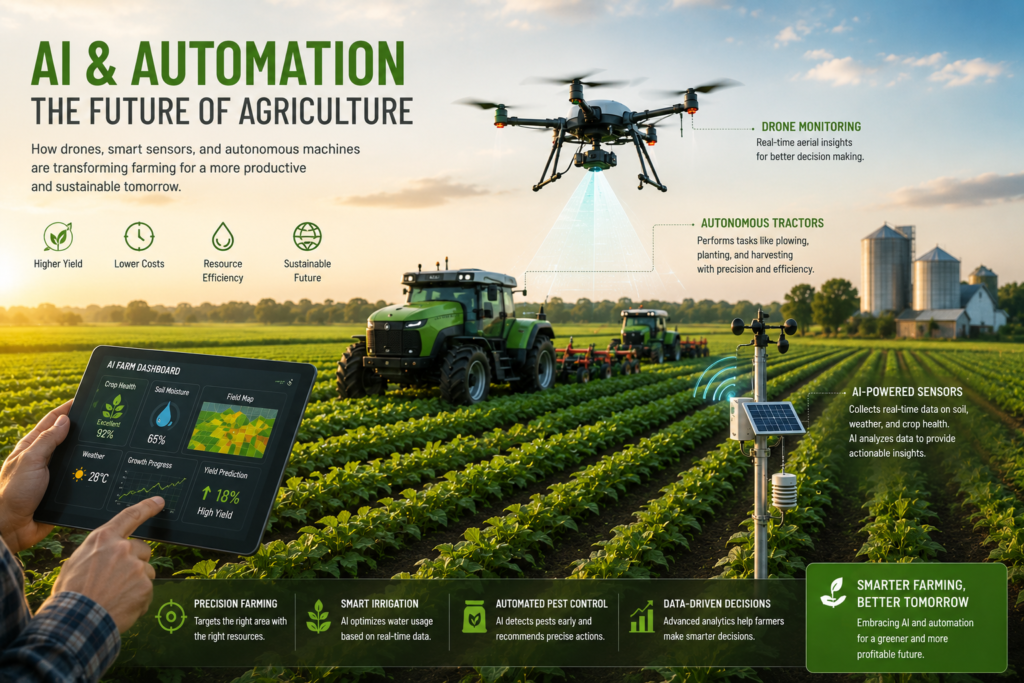
Agriculture has always been one of the most important sectors for human survival and economic growth. In earlier times, farming mainly depended on manual labor, animals, and simple agricultural tools. As technology developed, farmers started using tractors, irrigation systems, fertilizers, and modern machinery to improve productivity. Today, agriculture is undergoing another major transformation through Artificial Intelligence (AI) and automation, which are making farming smarter, faster, and more efficient.
AI in agriculture helps farmers make better decisions by analyzing data related to crops, soil, weather, and farming conditions. Technologies such as drones, smart sensors, and AI-powered monitoring systems allow farmers to observe crop health and detect problems like pest attacks or nutrient deficiencies at an early stage. Automation also plays an important role by using machines for tasks such as planting, watering, spraying fertilizers, and harvesting crops with minimal human effort.
One of the biggest advantages of AI and automation is increased productivity and reduced farming costs. Smart irrigation systems help save water by supplying only the required amount to crops, while automated machinery reduces dependence on labor and saves time. Precision farming techniques also ensure the proper use of fertilizers and pesticides, which improves crop quality and supports environmentally friendly farming practices.
Although there are challenges such as high investment costs and lack of technical knowledge in rural areas, the future of agriculture is becoming increasingly technology-driven. AI and automation can help farmers meet the growing food demand while conserving natural resources. As more farmers adopt smart farming technologies, agriculture will continue to become more sustainable, productive, and efficient for future generations.
AI in Agriculture
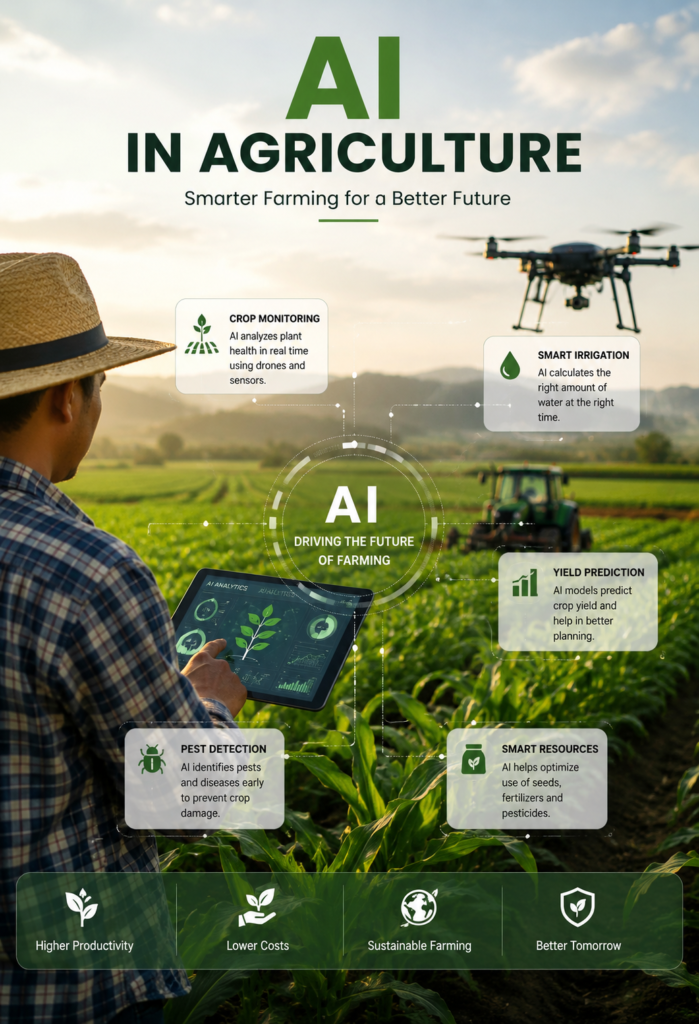
Artificial Intelligence (AI) in agriculture refers to the use of advanced computer systems and smart technologies to improve farming activities. AI can analyze large amounts of agricultural data, identify patterns, and help farmers make accurate decisions. These technologies support farmers in important tasks such as crop monitoring, soil analysis, weather forecasting, pest detection, and farm management. By using AI, farmers can improve efficiency and reduce the risks associated with farming.
AI systems gather information from different sources such as satellites, drones, sensors, cameras, and GPS devices. These tools continuously monitor field conditions, crop health, moisture levels, temperature, and other important agricultural factors. The collected data is processed and analyzed using AI software, which provides useful insights and recommendations to farmers. This helps farmers identify problems at an early stage and take corrective actions quickly.
One of the major benefits of AI in agriculture is improved productivity and better crop quality.
Automation in Agriculture
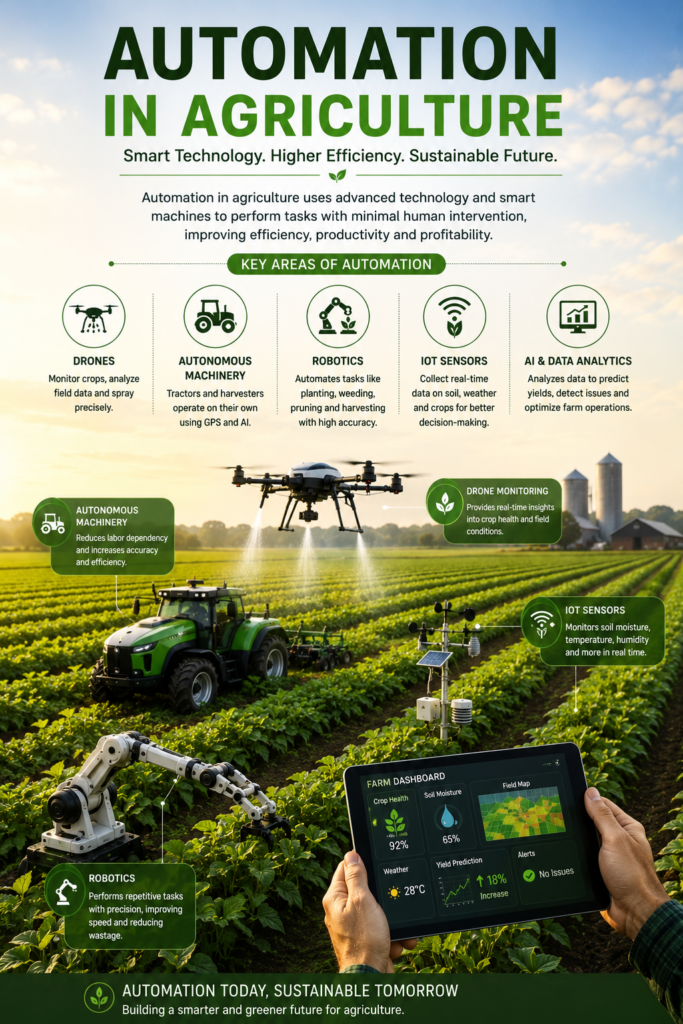
Automation means using machines and technology to perform farming tasks with minimal human effort. Automated farming equipment can work faster and more accurately compared to manual labor.
Some examples of agricultural automation include:
- Automatic irrigation systems
- Driverless tractors
- Robotic harvesting machines
- Seed planting machines
- Smart spraying systems
- Drone-based crop monitoring
These technologies help farmers reduce labor dependency and improve efficiency in agricultural operations.
Technologies Used in Smart Agriculture
Drones
Smart sensors
AI-Powered Robots
Automated Tractors
Precision Farming
Advantages and Disadvantages in AI and Automation in Agriculture
Advantages of AI and Automation in Agriculture
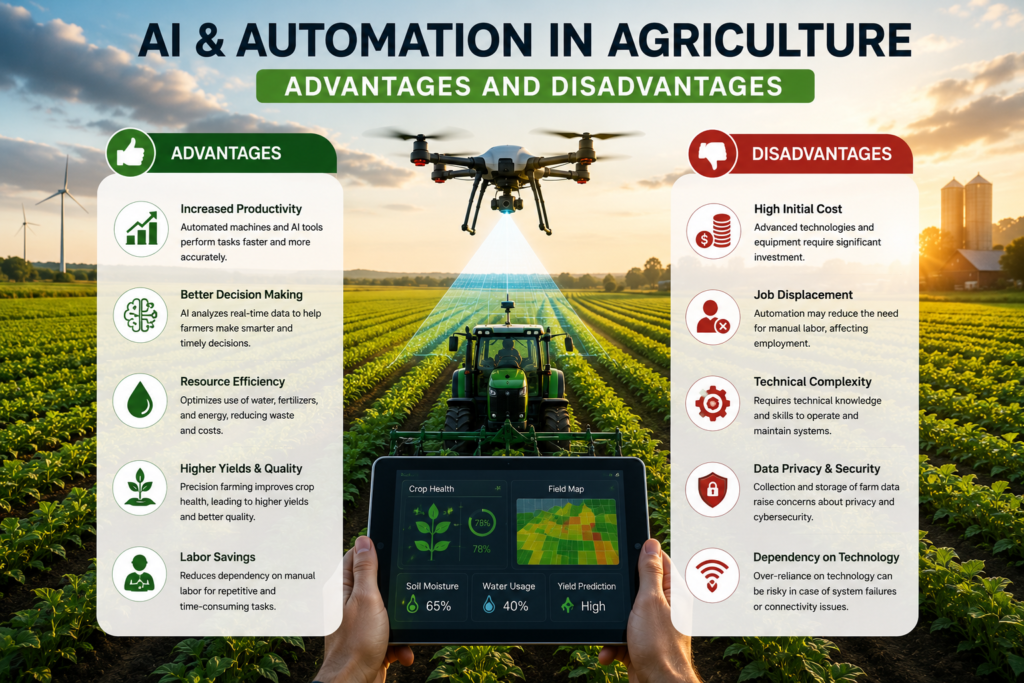
AI and automation provide several important benefits in agriculture by improving productivity, efficiency, and farm
management. AI-powered tools help farmers monitor crop health and soil conditions in real time, while automated
machinery performs farming tasks quickly and accurately, leading to higher crop yields. Technologies such as drones
and smart cameras help in better crop monitoring by detecting plant diseases, pest attacks, and nutrient deficiencies
at an early stage, allowing farmers to take preventive actions. Smart irrigation systems support water conservation by
supplying the exact amount of water required for crops, reducing wastage and promoting sustainable farming.
Automation also reduces labor costs by using machines for repetitive tasks such as planting, spraying, and harvesting,
saving both time and expenses. In addition, AI systems provide accurate weather predictions that help farmers plan
agricultural activities more effectively. By using real-time data and AI-generated insights, farmers can make better
decisions related to crop management, irrigation, and resource utilization, ultimately improving overall agricultural
productivity and reducing farming risks.
Disadvantages of AI and Automation in Agriculture
Although Artificial Intelligence (AI) and automation offer many advantages in agriculture, farmers also face several
challenges while adopting these advanced technologies. One of the biggest challenges is the high initial investment
cost required to purchase modern farming equipment such as drones, smart sensors, automated tractors, robotic
machines, and AI-based software systems. Many small and medium-scale farmers may not have enough financial
resources to invest in these expensive technologies, especially in developing countries where farming income is often
uncertain. In addition to the cost of equipment, farmers may also need to spend money on installation, training,
internet services, software updates, and maintenance, which further increases the financial burden. Another major
challenge is the lack of technical knowledge and digital literacy among farmers. Many farmers, particularly older
farmers and those living in rural areas, may not be familiar with operating advanced technological systems or
understanding AI-generated data and recommendations. Without proper training and awareness programs, it
becomes difficult for them to fully utilize the benefits of smart farming technologies. Dependence on internet
connectivity and electricity is another significant issue in agricultural automation. Most AI-powered systems require a
stable internet connection, GPS signals, and continuous electricity supply to function effectively. However, many rural
farming areas still face poor internet connectivity, frequent power shortages, and limited digital infrastructure, which
can affect the performance and reliability of automated farming systems. Moreover, adapting to new technologies can
be challenging for farmers who have been using traditional farming methods for many years. Some farmers may
hesitate to adopt AI and automation due to fear of technology, lack of confidence, or concerns about machine
reliability and job replacement.
Difference Between Traditional Agriculture & AI and Automation in Agriculture
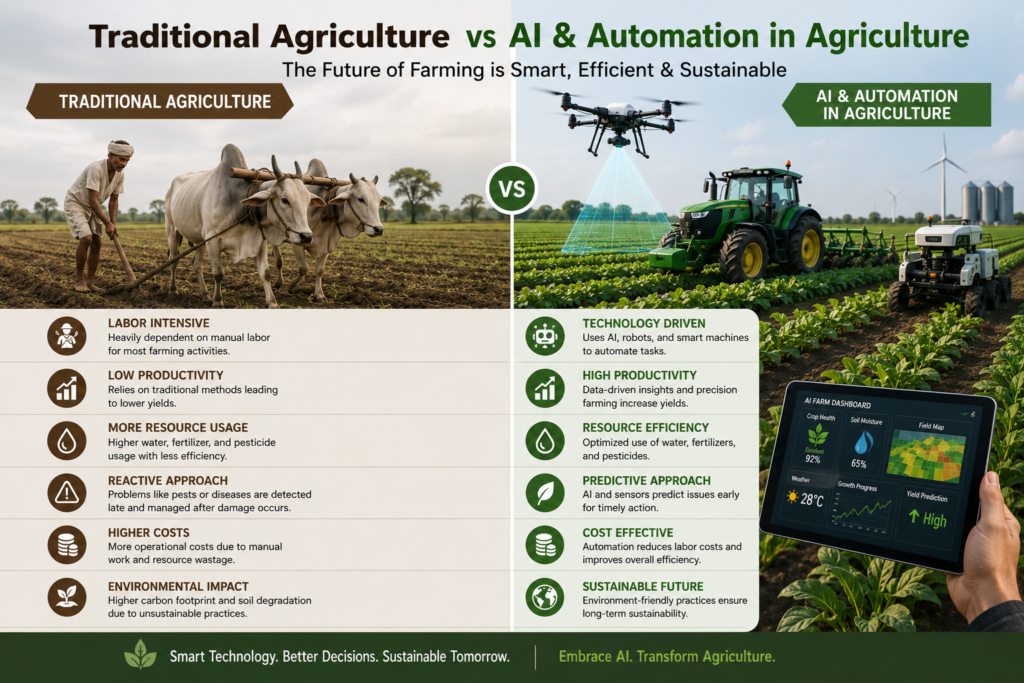
Traditional Agriculture
manual labor, animal power, and basic farming
tools for carrying out agricultural activities.
Farmers traditionally use simple methods for
plowing, sowing, irrigation, weeding, and
harvesting crops. Decision-making in traditional
farming is usually based on personal experience,
seasonal patterns, and local knowledge passed
down through generations. Most farming
activities require a large workforce, which
increases labor dependency and consumes
more time and effort. Traditional irrigation
methods often lead to excessive water usage
because farmers may not have accurate
information about soil moisture levels or crop
water requirements. Similarly, fertilizers and
pesticides are generally applied uniformly across
the field without analyzing the actual needs of
the crops, which can sometimes reduce soil
fertility and increase production costs. Crop
monitoring in traditional agriculture is done
manually, making it difficult to identify diseases,
pest attacks, or nutrient deficiencies at an early
stage. Weather prediction also depends mostly
on observation and past experience, which may
not always be accurate. Although traditional
agriculture has supported human life for
centuries and remains important in many rural
areas, it often results in lower productivity and
limited efficiency compared to modern farming
methods. Farmers may face challenges such as
unpredictable weather conditions, labor
shortages, and crop losses due to lack of
advanced technology. However, traditional
farming methods are usually less expensive
initially and are more suitable for small farmers
who cannot afford modern machinery. In many
regions, traditional agriculture also promotes
natural farming practices and preserves cultural
farming traditions. Despite its limitations,
traditional agriculture continues to play an
important role in food production, especially in
developing countries where access to advanced
technology and infrastructure may still be limited
V/S
AI and Automation in Agriculture
advanced technologies such as artificial intelligence,
drones, smart sensors, GPS systems, robotic
machines, and automated tractors to improve farming
efficiency and productivity. Unlike traditional farming,
modern smart farming relies on real-time data
analysis and technology-driven decision-making. AI
systems can monitor crop health, soil conditions,
weather patterns, and irrigation requirements with
high accuracy, helping farmers make informed
decisions quickly. Automation reduces the need for
manual labor by using machines for tasks such as
planting, spraying pesticides, irrigating fields, and
harvesting crops. Drones and smart cameras can
capture aerial images of farmland and identify crop
diseases, pest attacks, and nutrient deficiencies at an
early stage, allowing farmers to take preventive action
immediately. Precision farming techniques help apply
fertilizers, pesticides, and water only where needed,
reducing wastage and improving resource
management. AI-powered weather forecasting
systems also provide accurate climate predictions,
helping farmers plan agricultural activities more
effectively and reduce risks caused by unexpected
weather changes. Automated tractors and robotic
equipment can work continuously with high precision,
saving time and reducing operational costs. Although
AI and automation require high initial investment and
technical knowledge, they significantly improve
productivity, crop quality, and sustainability in
agriculture. These technologies also help conserve
natural resources such as water and soil by promoting
efficient farming practices. AI-based agriculture
supports large-scale farming operations and helps
meet the growing global demand for food production.
As technology continues to develop, AI and
automation are expected to transform agriculture into
a smarter, more sustainable, and highly efficient
industry, helping farmers increase profits while
improving overall agricultural development.
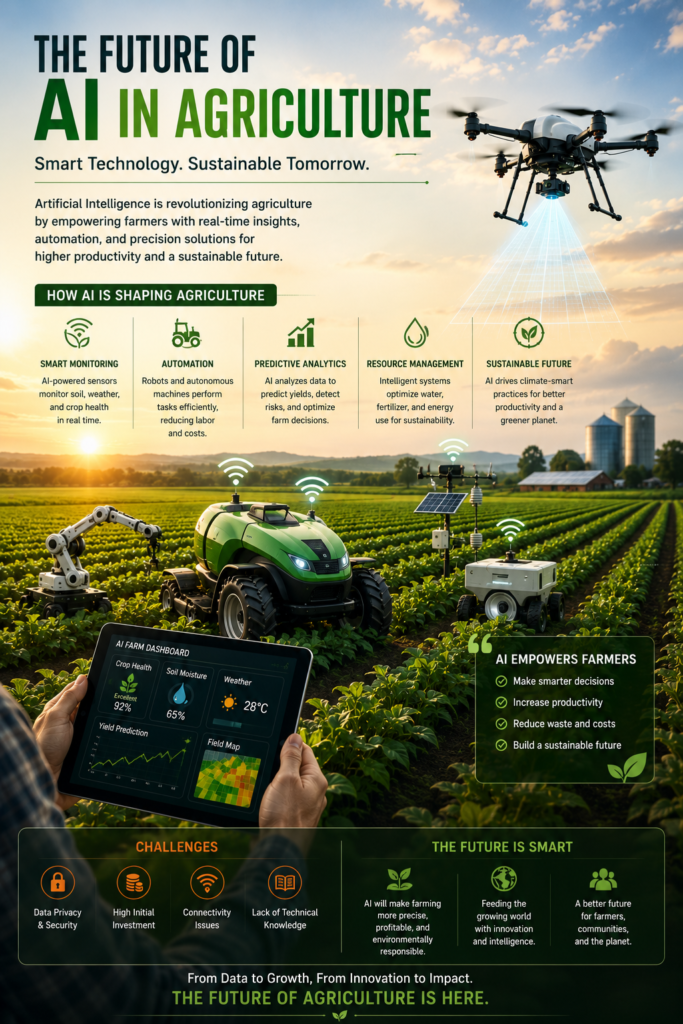
Future of AI in Agriculture
The future of Artificial Intelligence (AI) in agriculture is highly promising and is expected to transform farming into a smarter, more efficient, and sustainable industry. As the global population continues to increase, the demand for food production will also rise rapidly. AI technologies can help farmers meet this growing demand by improving productivity, reducing wastage, and managing natural resources more effectively. In the coming years, advanced technologies such as drones, smart sensors, robotic harvesters, automated tractors, and AI-powered monitoring systems will become more common in agricultural activities.
AI will help farmers make better decisions by providing accurate information about weather conditions, soil health, crop diseases, irrigation needs, and market trends. Precision farming techniques will allow farmers to use water, fertilizers, and pesticides more efficiently, reducing environmental impact and supporting sustainable agriculture. Automation will also reduce labor dependency and improve farming speed and accuracy.
Conclusion
Artificial Intelligence and automation are bringing a major transformation to the agricultural sector by making farming more efficient, productive, and sustainable. Modern technologies such as drones, smart sensors, AI-powered robots, automated tractors, and precision farming systems are helping farmers improve crop monitoring, reduce labor costs, conserve water, and make better farming decisions. These innovations not only increase agricultural productivity but also support environmental conservation by reducing the wastage of natural resources.
Although there are challenges such as high investment costs, lack of technical knowledge, and limited infrastructure in rural areas, the long-term benefits of AI and automation are significant. With proper training, government support, and technological development, more farmers will be able to adopt smart farming practices in the future. AI-based agriculture has the potential to improve food security, increase farmer income, and meet the growing global demand for food production.
Overall, the integration of AI and automation is shaping the future of agriculture by combining technology with traditional farming knowledge. As these technologies continue to develop, agriculture will become smarter, faster, and more sustainable, helping farmers achieve better productivity while protecting natural resources for future generations.